Yesterday I finished reading Let's Pretend This Never Happened by Jenny Lawson (aka The Bloggess).
And there's a hole in my life in the shape of an enormous metal chicken that I think can only be filled by a deranged-looking taxidermied raccoon.
The Bloggess posts frequently on her blog that she has found her tribe, thanks to the Internet. She's found people just as strange and broken as she is, and has been able to connect with them and make friends and feel not alone, especially when depression is lying to her. I have found that through her blog and memoir, too.
Everyone is broken. And when we find somewhere in which we can be broken and still magical, we win. Not only does Lawson's memoir show people that they can be broken and magical, but she does it with the same brilliant, acerbic style that brings me back to her blog with every new post.
She manages to talk about the very serious, scary things she has experienced wedged between absurd comedy that makes the overall memoir feel much lighter than it actually is. When you get finished, it's as if you've read a comedy, not a book that talks about rare medical problems, mental illness, miscarriage, and traumatic experiences with all the seriousness those topics deserve.
Lawson's memoir proves that she is more than the sum of her parts. Yes, she has had these experiences and difficulties and an incredible weirdness in her life, but she cannot -- and will not -- be defined by any of them. Or even all of them. Because, in the end, we're all just stumbling around until we find our tribe. She found hers.
If you're still looking for yours, or want confirmation that you're not nearly as weird as you think you are, or need a reminder that depression lies, please pick up her book. Read her blog. Follow her on Facebook or Twitter. Reach out in some way and know that you are not alone.
We're all a little mad here. Jenny Lawson just manages to talk about it in a way that makes you laugh.
Showing posts with label reading. Show all posts
28 August 2015
22 August 2015
Challenge accepted!
Some time ago I tried (unsuccessfully) the 100 books in a year challenge. It was embarrassing how badly I failed.
I'm a different person now, and I have a different daily schedule and life, and I want to do it again. But I don't want to wait until January 1st to start, so I'm starting now.
My goal is to read 100 books by August 21, 2016. I'll be using my discretion as to what books count. Children's picture books that I read to the kids won't count, but if I read Alice's Adventures in Wonderland or The Wind in the Willows to them, that does count. I have to begin and finish the book for it to count. Rereads count (because there's nothing wrong with rereading a great book).
I'll be checking in around the 22nd of each month for an update, and I'll likely write little reviews and reflections of what I read each week (or at least once a month).
My amazing fiance gave me 52 books for Christmas last year, so I have quite a lengthy list from which to start.
I hope that this challenge will help me make more time to read for pleasure, which is one area I find myself lacking lately. If I need time for something else, reading is typically the first thing to go. I want (and need) to read more. For my sanity, for my writing, and for my own edification.
And what better place to start than with Jenny Lawson's Let's Pretend This Never Happened?
What are you reading this month?
I'm a different person now, and I have a different daily schedule and life, and I want to do it again. But I don't want to wait until January 1st to start, so I'm starting now.
My goal is to read 100 books by August 21, 2016. I'll be using my discretion as to what books count. Children's picture books that I read to the kids won't count, but if I read Alice's Adventures in Wonderland or The Wind in the Willows to them, that does count. I have to begin and finish the book for it to count. Rereads count (because there's nothing wrong with rereading a great book).
I'll be checking in around the 22nd of each month for an update, and I'll likely write little reviews and reflections of what I read each week (or at least once a month).
My amazing fiance gave me 52 books for Christmas last year, so I have quite a lengthy list from which to start.
I hope that this challenge will help me make more time to read for pleasure, which is one area I find myself lacking lately. If I need time for something else, reading is typically the first thing to go. I want (and need) to read more. For my sanity, for my writing, and for my own edification.
And what better place to start than with Jenny Lawson's Let's Pretend This Never Happened?
What are you reading this month?
19 March 2015
Do you have to read a book to have an opinion about it?
Not too long ago, I engaged in a rather heated discussion on Facebook about the release of the film Fifty Shades of Grey (FSOG).
I will be honest: I have not read the books and I have not seen the movie. And I have very specific reasons as to why that has been the case.
Part of the "problem" that others saw in the midst of the discussion was that I have an opinion about FSOG but haven't read the books. They took the position that, as a writer and reader, it is unfair and irresponsible for me to judge the books based on the opinions of others (blog posts and articles) and excerpts I've read online.
I didn't really argue the point. Much of the passionate reaction I received was due more to me critiquing (harshly) something they liked rather than an objective argument in favor of the literature.
Yes, it's true that I haven't read the books. However, based on the content of the story and the many, many, many articles (and even a research study) I've read about them, I know that I wouldn't like them. I know they would make me mad.
I don't have to read the books in order to be justified in that opinion.
Along the same lines, I am not a fan of chick lit. I don't have to read every chick lit story to determine whether or not I actually like it (or the genre).
However, FSOG is different. My qualms with the trilogy is not in the construction of the genre or the flat story. There are darker issues as play that make me dislike the author's works.
I know FSOG has been blogged by many, many wonderful bloggers. And I believe the accounts I've read.
But I also know that there are people I know who enjoy the trilogy very much who have histories of domestic violence in their lives. There is a person in my life who complains about a Christian Grey-esque man in her own life in one breath, and romanticizes the trilogy in the next. There is a person in my life who escaped a physically abusive relationship, and believes that Christian Grey is the ideal man.
These women I have always counted as strong, independent, wonderful women simply do not see the ugliness of the books (and film). They believe the romanticized media opinions that attempt to gloss over what the book is really about.
So I'm going to do a blog series about FSOG beginning at the end of this month. I will try to be as objective as possible, and record my notes and opinions as I read each of the books and watch the film. I will supplement my opinions with articles, blog posts, and other materials written about the books (and film). And I will present my opinions here for you to take or leave as you will.
I'm not expecting to change anyone's opinions about the trilogy or film. But for my own sanity, I have to do this. As someone who was in a dangerous relationship, I can't simply ignore what these women have said to me about those books.
I hope you will read my account, and, if you feel so inclined, pass it along to anyone you think needs to read it. And to everyone else.
I don't have to read the books to know what I think of them, but if it's evidence these individuals need, then that's what I'll provide.
I will be honest: I have not read the books and I have not seen the movie. And I have very specific reasons as to why that has been the case.
Part of the "problem" that others saw in the midst of the discussion was that I have an opinion about FSOG but haven't read the books. They took the position that, as a writer and reader, it is unfair and irresponsible for me to judge the books based on the opinions of others (blog posts and articles) and excerpts I've read online.
I didn't really argue the point. Much of the passionate reaction I received was due more to me critiquing (harshly) something they liked rather than an objective argument in favor of the literature.
Yes, it's true that I haven't read the books. However, based on the content of the story and the many, many, many articles (and even a research study) I've read about them, I know that I wouldn't like them. I know they would make me mad.
I don't have to read the books in order to be justified in that opinion.
Along the same lines, I am not a fan of chick lit. I don't have to read every chick lit story to determine whether or not I actually like it (or the genre).
However, FSOG is different. My qualms with the trilogy is not in the construction of the genre or the flat story. There are darker issues as play that make me dislike the author's works.
I know FSOG has been blogged by many, many wonderful bloggers. And I believe the accounts I've read.
But I also know that there are people I know who enjoy the trilogy very much who have histories of domestic violence in their lives. There is a person in my life who complains about a Christian Grey-esque man in her own life in one breath, and romanticizes the trilogy in the next. There is a person in my life who escaped a physically abusive relationship, and believes that Christian Grey is the ideal man.
These women I have always counted as strong, independent, wonderful women simply do not see the ugliness of the books (and film). They believe the romanticized media opinions that attempt to gloss over what the book is really about.
So I'm going to do a blog series about FSOG beginning at the end of this month. I will try to be as objective as possible, and record my notes and opinions as I read each of the books and watch the film. I will supplement my opinions with articles, blog posts, and other materials written about the books (and film). And I will present my opinions here for you to take or leave as you will.
I'm not expecting to change anyone's opinions about the trilogy or film. But for my own sanity, I have to do this. As someone who was in a dangerous relationship, I can't simply ignore what these women have said to me about those books.
I hope you will read my account, and, if you feel so inclined, pass it along to anyone you think needs to read it. And to everyone else.
I don't have to read the books to know what I think of them, but if it's evidence these individuals need, then that's what I'll provide.
17 November 2014
Reading for work
Over the next year and a half or so, the work I do is going to shift.* I can't give too many details right now, but I will say that it has to do with moving my target market to the holistic health and wellness sector.
To that end, I have a lot of books on my reading list right now that deal with health and wellness topics, including herbal remedies and reiki. Not only are these interesting to me on a personal level, but I find them helpful in moving forward with work.
Of course, as is often the case, the more I'm learning about these topics, the more I want to know. One area of study leads to another, which opens the door to something else, and it's all interrelated, of course.
I'm trying not to get too carried away, especially in these early stages of in-depth research. I don't want to overwhelm myself with information, especially since it's for work.
So I'm reading little by little, learning more about this broad topic so I can better provide for the needs of my clients, to better equip me to narrow my target market in the near future, and, most importantly, to help me take better care of myself by finding a balance between mind, body, and spirit.
And in the meantime, I have plenty of reading to keep me occupied.

-----
*Originally the plan was to make the shift at the beginning of this year or by next summer, but there are some aspects that have come up that are causing the shift to be pushed back a bit. So it's going to be another year before the shift really starts to happen.
To that end, I have a lot of books on my reading list right now that deal with health and wellness topics, including herbal remedies and reiki. Not only are these interesting to me on a personal level, but I find them helpful in moving forward with work.
Of course, as is often the case, the more I'm learning about these topics, the more I want to know. One area of study leads to another, which opens the door to something else, and it's all interrelated, of course.
I'm trying not to get too carried away, especially in these early stages of in-depth research. I don't want to overwhelm myself with information, especially since it's for work.
So I'm reading little by little, learning more about this broad topic so I can better provide for the needs of my clients, to better equip me to narrow my target market in the near future, and, most importantly, to help me take better care of myself by finding a balance between mind, body, and spirit.
And in the meantime, I have plenty of reading to keep me occupied.
-----
*Originally the plan was to make the shift at the beginning of this year or by next summer, but there are some aspects that have come up that are causing the shift to be pushed back a bit. So it's going to be another year before the shift really starts to happen.
22 September 2014
Efforts in reading for pleasure
I've been good at making excuses for not reading lately. Between moving and work ramping up and school starting, life has been busy. So I haven't been making time to read all the books I've started and haven't finished.
So I'm making a renewed effort at setting aside specific time to read.
That being said, here are the books I'm in the process of reading or that are on my current reading list.
The God Delusion by Richard Dawkins
I know that Richard Dawkins is not a good example of what it means to be a human being, but I bought the book and I'm interested in the topic, so I'm going to read it. I likely won't buy any more of his books. I'll be looking at other authors to continue my reading into atheism.
Quiet by Susan Cain
I'm rather late on reading this book about introverts, but I would still like to. So it's still on my list.
Olive Kitteridge by Elizabeth Strout
This novel won a Pulitzer, and is structured similarly to the way I would like to structure the coffee house book, so it was recommended to me by another writer. I haven't started it yet, but I'm looking forward to it. I'm hopeful it will be helpful in writing the coffee house book.
Once I'm (finally) done with these three, I'll move on to some of the other books on my reading list. There are always more books to read, aren't there? And I know that taking the time to read for pleasure will give me some much-needed down time throughout the week.
What are you reading?
So I'm making a renewed effort at setting aside specific time to read.
That being said, here are the books I'm in the process of reading or that are on my current reading list.
The God Delusion by Richard Dawkins
I know that Richard Dawkins is not a good example of what it means to be a human being, but I bought the book and I'm interested in the topic, so I'm going to read it. I likely won't buy any more of his books. I'll be looking at other authors to continue my reading into atheism.
Quiet by Susan Cain
I'm rather late on reading this book about introverts, but I would still like to. So it's still on my list.
Olive Kitteridge by Elizabeth Strout
This novel won a Pulitzer, and is structured similarly to the way I would like to structure the coffee house book, so it was recommended to me by another writer. I haven't started it yet, but I'm looking forward to it. I'm hopeful it will be helpful in writing the coffee house book.
Once I'm (finally) done with these three, I'll move on to some of the other books on my reading list. There are always more books to read, aren't there? And I know that taking the time to read for pleasure will give me some much-needed down time throughout the week.
What are you reading?
09 September 2014
Ten books that have stuck with me
The delightful, brilliant Chuck Wendig published an interesting post about ten books that have stuck with him.
It's an interesting list, and an interesting prompt. Lots of people are asked what books are their favorites, or what books have shifted their perspectives on the world, but books that "stick with you" is a different concept. It suggests writing or stories or characters that you connect with in a way that keeps the book in your mind long after you read it. Or perhaps it transforms the book into one that you read again and again.
Here's my list (in no particular order).
1. Jane Eyre by Charlotte Bronte
This was the first "big girl" book I read because I wanted to. I was in middle school I think, and I checked it out of the library one Friday. I spent the entire weekend reading it, taking in the story, learning about Jane, and falling in love with this new world of stories that extended so far beyond The Babysitter's Club and R. L. Stine. Here was an "adult" book. I read it and understood it. Perhaps not on as deep a level as I would now, but it was still read and enjoyed. It was the first time I read a book and didn't feel like a kid reading a book that was beyond me. Instead, I saw value in books that weren't written specifically for my grade level. I didn't have to stick to Ramona if I didn't want to. I could go into a library and read a book because it sounded interesting, and that was good enough reason to check it out. It's been quite some time since I've read Jane Eyre, but it's a story I know and love, and will be with me for a long, long time.
2. Catcher in the Rye by J. D. Salinger
I read Catcher in the Rye my sophomore year in high school. I was intrigued by the book because I had to have a permission slip signed in order to read it in class. And when I read it, I loved it. I liked the self-contradictory nature of Holden, I liked that Salinger hinted at events and moments rather than hitting the reader over the head with them, and I liked that throughout the reading, I didn't quite believe everything that Holden told me. I always felt like there was more to it. It was a book that was accessible to me, but challenged me in a new way as a reader. This was my first experience reading a book critically. I read it to understand it, and not just to read a story. After this book, I had a deeper appreciation for other stories I read. Because of that, Catcher will always have a special place in my personal library.
3. The Handmaid's Tale by Margaret Atwood
I didn't read The Handmaid's Tale until a women's literature course in college. This book has stuck with me because I know people of the religious ilk that would try and overthrow the government as described in the story. These people I know would be among those who would welcome a theocracy, and would likely contribute to some of the hypocrisy that would exist within the rigid, misogynistic government and society. Additionally, this book is a chilling reminder to me of why Christianity--and religion overall--can be a destructive, scary force in this world. And, as if that isn't enough, there are moments I read headlines or watch the news and Atwood's story immediately comes to mind. How much longer until it becomes reality?
4. Angela's Ashes by Frank McCourt
When I was a senior in high school, I took a British Literature class. During one quarter, we were asked to choose a book by a British author and do a report on it. I asked the teacher if I could choose Angela's Ashes--I argued that Ireland is, in fact, closely related to Britain and we did read The Importance of Being Earnest by Irish playwright Oscar Wilde, so could she really say no?--and was given permission. I think Angela's Ashes has stuck with me because it was the first book that evoked a real emotional response in me. I'd read books and been amused or saddened by what happened, but when I read Angela's Ashes, I wept. I had to put the book down because I couldn't read through the tears. It made me feel for the characters in a way I hadn't experienced through literature.
5. Their Eyes Were Watching God by Zora Neale Hurtson
I love this book. It's among my favorites. Like Gatsby, it's one of the books that reveals something new every time I read it. I learn more about Janie and her experiences, and find myself connecting to her on a different level each time. It's a beautiful, extremely well-written book, and one that I hope continues to be read in classrooms for generations. It's very much worth reading frequently. If there is any book on this list that haunts me, it is this one. I wish I could be more descriptive and explain exactly why I feel so connected to this book, but I can't. Sometimes stories just stick with you for lots of reasons (or none at all), and this is one of them.
6. The Bell Jar by Sylvia Plath
Is it a cliche to put this book on my list? As someone who has struggled with depression and anxiety, I discovered Plath at a good time in my life. I was struggling, and Esther's story made me feel a little less alone. Plath gave voice to my own experiences, in a much more eloquent way than I ever could. The Bell Jar, to me, said it was okay to struggle, and it was okay that others didn't really understand the struggle. It is, after all, my struggle. It's been quite some time since I've read The Bell Jar, but it's one that I always include in book lists because it has been important to me since high school.
7. The Great Gatsby by F. Scott Fitzgerald
I didn't read Gatsby until college. I know lots of people read it in high school, but I didn't. However, I'm glad for that. I think if I'd read it in high school, the obligation of reading it plus the discussions of the symbolism of Dr. T. J. Eckleburg's eyes and the green light at the end of the dock would have likely turned me off from really reading the story. And that would have been very sad. However, Gatsby gave me a very real experience of how literature rewards rereading. I've read it many times (and will continue to read it regularly), and each time I read it, I walk away from it feeling almost as if I've read it for the first time. I see the characters differently, connect with them differently, and interpret the story and its nuances differently. Every time I read The Great Gatsby, it is a new story to me. It has stuck with me since the first time I read it, and I look forward to every reread. And always will. I've heard there are two types of people in the world: those who are Gatsby people and those who are not. I am a Gatsby person.*
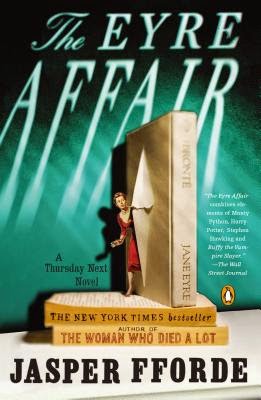
8. The Eyre Affair by Jasper Fforde
I discovered Jasper Fforde accidentally. I adored Jane Eyre, and saw The Eyre Affair on a bargain book rack at a bookstore, drawn to it because of the reference to Bronte's character in the title. However, when I read it, I was hooked, and Jasper Fforde became one of my favorite writers. This book, in particular, has stuck with me because of its whimsy. It's sort of a dream alternate reality for writers and readers, it has a strong female protagonist (I love Thursday's character!), and it takes what I knew about literature and fiction and sort of put it on its head. Fforde did something I'd never encountered in literature before (and haven't since), and that was enough to make me a fan. The fact that he did it so well has changed my reading life forever.
9. Wit by Margaret Edson
I read Wit in a college literature course. It's a play, and it's heartbreakingly beautiful. I love the concept of this play and its execution. I love the subtle scene shifts and the fluidity of the story as it is told. I love the complexity of Vivian's character, watching how she changes as her cancer changes her. And then when it comes to the end... Well, I don't want to spoil it for anyone who hasn't read it, so I'll just say that I cry every single time I read it. I think it's that characterization that has caused this play to stick with me. There is something about Vivian that I can't let go of. I desperately want to see Wit on stage.
10. "The Yellow Wallpaper" by Charlotte Perkins Gilman
This is a short story rather than a book, but important for me to include in this list. "The Yellow Wallpaper" was not the first story I read with an unreliable narrator (Catcher in the Rye was), but it was the first story I read in which I understood that the narrator was unreliable and studied it in my analysis of the story. Unreliable narrators fascinate me. I love that a reader only really has what the narrator says to understand the story, but an unreliable narrator can't necessarily be trusted. So the reader is left to sort out the story using clues dropped by the author. I love that. And that's why I like "The Yellow Wallpaper" so much. It gives the reader a glimpse into the narrator's world, which is not necessarily her reality, and the reader is left to sort of piece it all together and figure it out.
So that's my list. What's yours?

-----
*And the recent film? Seriously?
It's an interesting list, and an interesting prompt. Lots of people are asked what books are their favorites, or what books have shifted their perspectives on the world, but books that "stick with you" is a different concept. It suggests writing or stories or characters that you connect with in a way that keeps the book in your mind long after you read it. Or perhaps it transforms the book into one that you read again and again.
Here's my list (in no particular order).
1. Jane Eyre by Charlotte Bronte
This was the first "big girl" book I read because I wanted to. I was in middle school I think, and I checked it out of the library one Friday. I spent the entire weekend reading it, taking in the story, learning about Jane, and falling in love with this new world of stories that extended so far beyond The Babysitter's Club and R. L. Stine. Here was an "adult" book. I read it and understood it. Perhaps not on as deep a level as I would now, but it was still read and enjoyed. It was the first time I read a book and didn't feel like a kid reading a book that was beyond me. Instead, I saw value in books that weren't written specifically for my grade level. I didn't have to stick to Ramona if I didn't want to. I could go into a library and read a book because it sounded interesting, and that was good enough reason to check it out. It's been quite some time since I've read Jane Eyre, but it's a story I know and love, and will be with me for a long, long time.
2. Catcher in the Rye by J. D. Salinger
I read Catcher in the Rye my sophomore year in high school. I was intrigued by the book because I had to have a permission slip signed in order to read it in class. And when I read it, I loved it. I liked the self-contradictory nature of Holden, I liked that Salinger hinted at events and moments rather than hitting the reader over the head with them, and I liked that throughout the reading, I didn't quite believe everything that Holden told me. I always felt like there was more to it. It was a book that was accessible to me, but challenged me in a new way as a reader. This was my first experience reading a book critically. I read it to understand it, and not just to read a story. After this book, I had a deeper appreciation for other stories I read. Because of that, Catcher will always have a special place in my personal library.
3. The Handmaid's Tale by Margaret Atwood
I didn't read The Handmaid's Tale until a women's literature course in college. This book has stuck with me because I know people of the religious ilk that would try and overthrow the government as described in the story. These people I know would be among those who would welcome a theocracy, and would likely contribute to some of the hypocrisy that would exist within the rigid, misogynistic government and society. Additionally, this book is a chilling reminder to me of why Christianity--and religion overall--can be a destructive, scary force in this world. And, as if that isn't enough, there are moments I read headlines or watch the news and Atwood's story immediately comes to mind. How much longer until it becomes reality?
4. Angela's Ashes by Frank McCourt
When I was a senior in high school, I took a British Literature class. During one quarter, we were asked to choose a book by a British author and do a report on it. I asked the teacher if I could choose Angela's Ashes--I argued that Ireland is, in fact, closely related to Britain and we did read The Importance of Being Earnest by Irish playwright Oscar Wilde, so could she really say no?--and was given permission. I think Angela's Ashes has stuck with me because it was the first book that evoked a real emotional response in me. I'd read books and been amused or saddened by what happened, but when I read Angela's Ashes, I wept. I had to put the book down because I couldn't read through the tears. It made me feel for the characters in a way I hadn't experienced through literature.
5. Their Eyes Were Watching God by Zora Neale Hurtson
I love this book. It's among my favorites. Like Gatsby, it's one of the books that reveals something new every time I read it. I learn more about Janie and her experiences, and find myself connecting to her on a different level each time. It's a beautiful, extremely well-written book, and one that I hope continues to be read in classrooms for generations. It's very much worth reading frequently. If there is any book on this list that haunts me, it is this one. I wish I could be more descriptive and explain exactly why I feel so connected to this book, but I can't. Sometimes stories just stick with you for lots of reasons (or none at all), and this is one of them.
6. The Bell Jar by Sylvia Plath
Is it a cliche to put this book on my list? As someone who has struggled with depression and anxiety, I discovered Plath at a good time in my life. I was struggling, and Esther's story made me feel a little less alone. Plath gave voice to my own experiences, in a much more eloquent way than I ever could. The Bell Jar, to me, said it was okay to struggle, and it was okay that others didn't really understand the struggle. It is, after all, my struggle. It's been quite some time since I've read The Bell Jar, but it's one that I always include in book lists because it has been important to me since high school.
7. The Great Gatsby by F. Scott Fitzgerald
I didn't read Gatsby until college. I know lots of people read it in high school, but I didn't. However, I'm glad for that. I think if I'd read it in high school, the obligation of reading it plus the discussions of the symbolism of Dr. T. J. Eckleburg's eyes and the green light at the end of the dock would have likely turned me off from really reading the story. And that would have been very sad. However, Gatsby gave me a very real experience of how literature rewards rereading. I've read it many times (and will continue to read it regularly), and each time I read it, I walk away from it feeling almost as if I've read it for the first time. I see the characters differently, connect with them differently, and interpret the story and its nuances differently. Every time I read The Great Gatsby, it is a new story to me. It has stuck with me since the first time I read it, and I look forward to every reread. And always will. I've heard there are two types of people in the world: those who are Gatsby people and those who are not. I am a Gatsby person.*
8. The Eyre Affair by Jasper Fforde
I discovered Jasper Fforde accidentally. I adored Jane Eyre, and saw The Eyre Affair on a bargain book rack at a bookstore, drawn to it because of the reference to Bronte's character in the title. However, when I read it, I was hooked, and Jasper Fforde became one of my favorite writers. This book, in particular, has stuck with me because of its whimsy. It's sort of a dream alternate reality for writers and readers, it has a strong female protagonist (I love Thursday's character!), and it takes what I knew about literature and fiction and sort of put it on its head. Fforde did something I'd never encountered in literature before (and haven't since), and that was enough to make me a fan. The fact that he did it so well has changed my reading life forever.
9. Wit by Margaret Edson
I read Wit in a college literature course. It's a play, and it's heartbreakingly beautiful. I love the concept of this play and its execution. I love the subtle scene shifts and the fluidity of the story as it is told. I love the complexity of Vivian's character, watching how she changes as her cancer changes her. And then when it comes to the end... Well, I don't want to spoil it for anyone who hasn't read it, so I'll just say that I cry every single time I read it. I think it's that characterization that has caused this play to stick with me. There is something about Vivian that I can't let go of. I desperately want to see Wit on stage.
10. "The Yellow Wallpaper" by Charlotte Perkins Gilman
This is a short story rather than a book, but important for me to include in this list. "The Yellow Wallpaper" was not the first story I read with an unreliable narrator (Catcher in the Rye was), but it was the first story I read in which I understood that the narrator was unreliable and studied it in my analysis of the story. Unreliable narrators fascinate me. I love that a reader only really has what the narrator says to understand the story, but an unreliable narrator can't necessarily be trusted. So the reader is left to sort out the story using clues dropped by the author. I love that. And that's why I like "The Yellow Wallpaper" so much. It gives the reader a glimpse into the narrator's world, which is not necessarily her reality, and the reader is left to sort of piece it all together and figure it out.
So that's my list. What's yours?
-----
*And the recent film? Seriously?
14 August 2014
Keep reading, keep learning
I have a subscription to The Writer. I'd had a subscription previously, and when I moved back to Florida, I got it again. I thought, if nothing else, it will keep me motivated to keep moving forward in my writing.
I value this subscription. Not only do I look forward to getting each issue, but I read them, and keep the back issues to refer to later. I have a whole stack of magazines on my (make-shift, temporary because we're in the process of moving) desk.
One of the things I like about The Writer is that it gives a wide variety of information. Even if the overall theme of the issue doesn't really apply to me, I can find something that helps my writing.
Besides the encouragement and inspiration that comes from the magazine, it makes good sense from a career standpoint to read The Writer and other writer-focused magazines. (Writer's Digest is another good one.) For writers, the magazines can be considered trade magazines. They give information about news and insight into the industry, helping writers become better writers and advancing careers.
No matter what industry you're in, it's important to keep learning and stay on top of advancements in your field. Even though the publishing industry has remained largely unchanged since its inception (though e-books and the rise of self-publishing is changing that in recent years), writers should keep learning and reading and growing to be better writers.
The Writer is one way I can do that. Reading fiction (and non-fiction) is another way. I love that I have to read to improve the work I do.
How do you keep up with publishing/writing news?
I value this subscription. Not only do I look forward to getting each issue, but I read them, and keep the back issues to refer to later. I have a whole stack of magazines on my (make-shift, temporary because we're in the process of moving) desk.
One of the things I like about The Writer is that it gives a wide variety of information. Even if the overall theme of the issue doesn't really apply to me, I can find something that helps my writing.
Besides the encouragement and inspiration that comes from the magazine, it makes good sense from a career standpoint to read The Writer and other writer-focused magazines. (Writer's Digest is another good one.) For writers, the magazines can be considered trade magazines. They give information about news and insight into the industry, helping writers become better writers and advancing careers.
No matter what industry you're in, it's important to keep learning and stay on top of advancements in your field. Even though the publishing industry has remained largely unchanged since its inception (though e-books and the rise of self-publishing is changing that in recent years), writers should keep learning and reading and growing to be better writers.
The Writer is one way I can do that. Reading fiction (and non-fiction) is another way. I love that I have to read to improve the work I do.
How do you keep up with publishing/writing news?
05 July 2014
On my nightstand
I've had the best of intentions to read all spring. And as spring has progressed and work has gotten (happily) more intense, reading for pleasure has not been as big a priority.
However, while the munchkins are with Monty for their summer vacation, I'm going to try to set aside some time for reading and get caught up on the books I started this summer and didn't finish. Here's what stacked up on my nightstand for July.
The God Delusion by Richard Dawkins
I started this book some time ago, but haven't gotten very far, and haven't finished it. I very much want to read this book. Here's the thing--I already know what I think about the existence of a supernatural creator being (spoiler alert: I do not believe in god). However, by reading Dawkins (and others) I will be much-better equipped to discuss/debate with others about the existence of god, including being able to articulate arguments against it, and combat statements in favor of god's existence.
One of the most valuable tools we have is knowledge, and books like this can equip me with the knowledge I need to stand strong in my beliefs.
Quiet by Susan Cain
This is another one of those books I started and haven't finished.
I know introversion is a big buzzword these days, and since high school I've sort of struggled with my introversion, especially when people would tell me I just needed to come out of my shell or "just go and meet people" or whatever other extroverted advice they had to offer (with the best of intentions, of course).
I'm hoping that reading Quiet will help me better relate to people who are more on the extroverted side of the scale and maybe "come out of my shell" a bit more. Bo* assures me that staying home for weeks at a time is not the best idea. So maybe reading Cain's book will help me find new ways to be a little more extroverted without it being quite so draining.
The Warcraft War of the Ancients Archive by Richard A. Knaak
I know. My geek is showing.
I play World of Warcraft, and because I was away from it so long when the kids were born, I'm feeling the need to read the lore so I can better appreciate the story of the game. Bo has (almost) all the books in the series, so I'm borrowing them from her.
I don't read a lot of fantasy, so I'm looking forward to this sort of escape this month.
What are you reading? What are you planning to read?

-----
*Bo is what the munchkins call Yvaine now. I like it--it suits her.
However, while the munchkins are with Monty for their summer vacation, I'm going to try to set aside some time for reading and get caught up on the books I started this summer and didn't finish. Here's what stacked up on my nightstand for July.
The God Delusion by Richard Dawkins
I started this book some time ago, but haven't gotten very far, and haven't finished it. I very much want to read this book. Here's the thing--I already know what I think about the existence of a supernatural creator being (spoiler alert: I do not believe in god). However, by reading Dawkins (and others) I will be much-better equipped to discuss/debate with others about the existence of god, including being able to articulate arguments against it, and combat statements in favor of god's existence.
One of the most valuable tools we have is knowledge, and books like this can equip me with the knowledge I need to stand strong in my beliefs.
Quiet by Susan Cain
This is another one of those books I started and haven't finished.
I know introversion is a big buzzword these days, and since high school I've sort of struggled with my introversion, especially when people would tell me I just needed to come out of my shell or "just go and meet people" or whatever other extroverted advice they had to offer (with the best of intentions, of course).
I'm hoping that reading Quiet will help me better relate to people who are more on the extroverted side of the scale and maybe "come out of my shell" a bit more. Bo* assures me that staying home for weeks at a time is not the best idea. So maybe reading Cain's book will help me find new ways to be a little more extroverted without it being quite so draining.
The Warcraft War of the Ancients Archive by Richard A. Knaak
I know. My geek is showing.
I play World of Warcraft, and because I was away from it so long when the kids were born, I'm feeling the need to read the lore so I can better appreciate the story of the game. Bo has (almost) all the books in the series, so I'm borrowing them from her.
I don't read a lot of fantasy, so I'm looking forward to this sort of escape this month.
What are you reading? What are you planning to read?
-----
*Bo is what the munchkins call Yvaine now. I like it--it suits her.
05 February 2014
Making time to read for fun
Though life and writing has been pretty busy lately, I've been trying to make time to read for fun lately. I don't read enough.
I've decided not to commit to a reading challenge this year because making any time to read is challenge enough for me. Instead, I'm just going to keep setting time aside to read things that interest me.
I'm in the middle of three books right now (two of them recommended by my dear friend Dana). I manage a few pages here and there, but kids and work takes precedence. So I'm trying to carve time out of other areas to specifically set aside for reading.
I know that devoting more time to reading will be good for me. It will help me slow down a little and take time away from work and enjoy quiet moments. It seems there haven't been enough quiet moments lately, so I'll take them where I can get them.
Have you been making time to read lately? What's on your nightstand?
I've decided not to commit to a reading challenge this year because making any time to read is challenge enough for me. Instead, I'm just going to keep setting time aside to read things that interest me.
I'm in the middle of three books right now (two of them recommended by my dear friend Dana). I manage a few pages here and there, but kids and work takes precedence. So I'm trying to carve time out of other areas to specifically set aside for reading.
I know that devoting more time to reading will be good for me. It will help me slow down a little and take time away from work and enjoy quiet moments. It seems there haven't been enough quiet moments lately, so I'll take them where I can get them.
Have you been making time to read lately? What's on your nightstand?
31 January 2014
Six Books That Changed My Life
Emily from Live Renewed had a post this week about the six books that have changed her life.
I think that's a very weighty label, isn't it? Don't get me wrong--I've read many books that have impacted me greatly. But to say a book has changed your life is a big deal. Not something that should be casually thrown around.
Still, I think it's important to be open so that important books can change your life. It's one way we can grow and become better people than we were.
For the purposes of this blog, I'll say that I consider a life-changing book one that shifted the way I see the world and relationships in it, and one that I could read more than once.* These are the books that, when I read the last page, I say something along the lines of "Holy shit."
So I've taken some time to think about what six books fall under the "life-changing" category for me. I present them here (in no particular order), with a short explanation of why.
Jane Eyre by Charlotte Bronte
I first read Jane Eyre in eighth grade. It was my first foray into adult classic literature. I don't remember why I chose it, but I read the whole thing in about two days. I let it sit in my room for a few days, then read it again.
The story of an orphaned governess transformed me as a reader. Until I read Jane Eyre, I stayed securely in the reading deemed by the Powers That Be to be appropriate for my age and grade level. Sure, I took on Accelerated Reader challenges excitedly, but this was the first time I read something I considered an "adult" novel. It opened up a new world of reading to me. Because I read it and (sort of) understood it, I realized I didn't have to keep reading R. L. Stine and Bonnie Byrant. I could choose books based on what sounded interesting to me, and ignore whether the books were "for my age" or not. My reading life was never the same after that.
The Catcher in the Rye by J. D. Salinger
I read this in ninth grade English. I'd just moved from another state and had about a month of school left until summer vacation, and the class had already started reading it. I remember that my parents had to sign a release form saying I had permission to read it for class. That was new for me.
This was my first experience with an unreliable narrator, which kind of blew my mind at the time. It was very, very strange to me that the person telling the story couldn't be entirely trusted. Until then, I'd always taken narrators at their words. But Holden Caulfield was a very different character. He only gave part of the story. He contradicted himself. I didn't really know what to make of him at first. After that, I was more careful about what I believed when I read stories.
The God Delusion by Richard Dawkins
I'm still in the process of reading this, so I was a little conflicted about including it in this list. But even only part of the way into the book, I can say it's a life-changer for me.
I'm new to atheism after a lifetime of Christianity (in various forms). And even though I know I do not believe in any supreme being/intelligent creator/god, I am far less versed in atheism than others are, and than others are in Christianity. I know what I think and believe, but I'm unable to coherently debate it or offer evidence against the existence of god. Yet. However, Dawkins is not only helping me articulate my thoughts, but is helping me better understand the scientific evidence behind atheism. It's helping me combat the "truths" I've been taught my whole life, and reminding me of why I've taken that step to atheism instead of simply claiming to be "spiritual" or "non-religious." This book really is changing the way I look at the world because I'm better able to see the wonder and beauty and terrible parts of the universe without tainting it by giving credit to a creator.
The Great Gatsby by F. Scott Fitzgerald
You're either a Gatsby person or you're not. I am.
I can't remember the first time I read The Great Gatsby. Probably high school. And I probably didn't appreciate it as much as I could have that first time. But I remember the second time I read it. Because it was the first time a book made me cry. Sure, I'd read books that touched me and made me feel sad, but this was the first time there were actual tears as a I read a book. I cried for Jay and for his father. I've read the book many times since*, and each time it's made me cry. Gatsby has touched me in a way other books haven't, and has grown and changed with me through its many readings. I'm a Gatsby person.
The Bell Jar by Sylvia Plath
It seems to me a little cliche that I would add this book, but I do have good reason.
When I was in high school (and college), I struggled with depression and anxiety. At the time, there weren't a lot of people around me going through similar struggles, so I felt very alone. When I read The Bell Jar, I felt a little less alone in what I was going through. I felt that, maybe, others had the same struggles. I know Esther Greenwood and Sylvia Plath are not the best models of recovery, but just knowing that I wasn't alone in what I was feeling was enough for me to be able to push through it. And, more importantly, ask for help when I needed it. In that way, I think Esther's story made me a better person, so it must be included in this list.
The Gift of Stories: Practical and Spiritual Applications of Autobiography, Life Stories, and Personal Mythmaking by Robert Atkinson
I read this book my senior year in college when I took a directed study course on personal mythmaking with my academic advisor. I really enjoyed the course not only because it was with a man I admire very deeply, but because of this book.
By learning more about life stories and personal mythmaking, I learned the value of people sharing their own stories. Until then, I knew it was important for people to have a voice, but there was a disconnection between my realization of that fact and the application in my life, words, and behavior. After reading this book, I better understood the value of telling people's stories, and people telling their own stories. Everyone deserves a voice. By telling their stories or letting others tell their stories, they're given a voice. Thanks to Atkinson's book, I understand that better now, and want to do what I can to make sure people's voices are protected.
It's a hard thing to decide what books have changed my life. I wasn't sure that I'd be able to come up with six titles. Yes, there are books that have made an impact on me. In fact, most books I read impact me in some way or another. But I wouldn't call them all life-changing. But these six have earned their place.
What books have changed your life?

-----
*Literature rewards rereading.
I think that's a very weighty label, isn't it? Don't get me wrong--I've read many books that have impacted me greatly. But to say a book has changed your life is a big deal. Not something that should be casually thrown around.
Still, I think it's important to be open so that important books can change your life. It's one way we can grow and become better people than we were.
For the purposes of this blog, I'll say that I consider a life-changing book one that shifted the way I see the world and relationships in it, and one that I could read more than once.* These are the books that, when I read the last page, I say something along the lines of "Holy shit."
So I've taken some time to think about what six books fall under the "life-changing" category for me. I present them here (in no particular order), with a short explanation of why.
Jane Eyre by Charlotte Bronte
I first read Jane Eyre in eighth grade. It was my first foray into adult classic literature. I don't remember why I chose it, but I read the whole thing in about two days. I let it sit in my room for a few days, then read it again.
The story of an orphaned governess transformed me as a reader. Until I read Jane Eyre, I stayed securely in the reading deemed by the Powers That Be to be appropriate for my age and grade level. Sure, I took on Accelerated Reader challenges excitedly, but this was the first time I read something I considered an "adult" novel. It opened up a new world of reading to me. Because I read it and (sort of) understood it, I realized I didn't have to keep reading R. L. Stine and Bonnie Byrant. I could choose books based on what sounded interesting to me, and ignore whether the books were "for my age" or not. My reading life was never the same after that.
I read this in ninth grade English. I'd just moved from another state and had about a month of school left until summer vacation, and the class had already started reading it. I remember that my parents had to sign a release form saying I had permission to read it for class. That was new for me.
This was my first experience with an unreliable narrator, which kind of blew my mind at the time. It was very, very strange to me that the person telling the story couldn't be entirely trusted. Until then, I'd always taken narrators at their words. But Holden Caulfield was a very different character. He only gave part of the story. He contradicted himself. I didn't really know what to make of him at first. After that, I was more careful about what I believed when I read stories.
I'm still in the process of reading this, so I was a little conflicted about including it in this list. But even only part of the way into the book, I can say it's a life-changer for me.
I'm new to atheism after a lifetime of Christianity (in various forms). And even though I know I do not believe in any supreme being/intelligent creator/god, I am far less versed in atheism than others are, and than others are in Christianity. I know what I think and believe, but I'm unable to coherently debate it or offer evidence against the existence of god. Yet. However, Dawkins is not only helping me articulate my thoughts, but is helping me better understand the scientific evidence behind atheism. It's helping me combat the "truths" I've been taught my whole life, and reminding me of why I've taken that step to atheism instead of simply claiming to be "spiritual" or "non-religious." This book really is changing the way I look at the world because I'm better able to see the wonder and beauty and terrible parts of the universe without tainting it by giving credit to a creator.
The Great Gatsby by F. Scott Fitzgerald
You're either a Gatsby person or you're not. I am.
I can't remember the first time I read The Great Gatsby. Probably high school. And I probably didn't appreciate it as much as I could have that first time. But I remember the second time I read it. Because it was the first time a book made me cry. Sure, I'd read books that touched me and made me feel sad, but this was the first time there were actual tears as a I read a book. I cried for Jay and for his father. I've read the book many times since*, and each time it's made me cry. Gatsby has touched me in a way other books haven't, and has grown and changed with me through its many readings. I'm a Gatsby person.
The Bell Jar by Sylvia Plath
It seems to me a little cliche that I would add this book, but I do have good reason.
When I was in high school (and college), I struggled with depression and anxiety. At the time, there weren't a lot of people around me going through similar struggles, so I felt very alone. When I read The Bell Jar, I felt a little less alone in what I was going through. I felt that, maybe, others had the same struggles. I know Esther Greenwood and Sylvia Plath are not the best models of recovery, but just knowing that I wasn't alone in what I was feeling was enough for me to be able to push through it. And, more importantly, ask for help when I needed it. In that way, I think Esther's story made me a better person, so it must be included in this list.
The Gift of Stories: Practical and Spiritual Applications of Autobiography, Life Stories, and Personal Mythmaking by Robert Atkinson
I read this book my senior year in college when I took a directed study course on personal mythmaking with my academic advisor. I really enjoyed the course not only because it was with a man I admire very deeply, but because of this book.
By learning more about life stories and personal mythmaking, I learned the value of people sharing their own stories. Until then, I knew it was important for people to have a voice, but there was a disconnection between my realization of that fact and the application in my life, words, and behavior. After reading this book, I better understood the value of telling people's stories, and people telling their own stories. Everyone deserves a voice. By telling their stories or letting others tell their stories, they're given a voice. Thanks to Atkinson's book, I understand that better now, and want to do what I can to make sure people's voices are protected.
It's a hard thing to decide what books have changed my life. I wasn't sure that I'd be able to come up with six titles. Yes, there are books that have made an impact on me. In fact, most books I read impact me in some way or another. But I wouldn't call them all life-changing. But these six have earned their place.
What books have changed your life?
-----
*Literature rewards rereading.
19 October 2013
It's book order day! Calloo! Callay!
When I was a kid, some of my favorite school days were the days the teacher sent home the order booklets for Scholastic books. We would usually get the booklets earlyish in the day, and when I had a moment, I'd go through the pages and mark the books I wanted my parents to order for me.
I never got all the books I wanted in any given order, but my parents did order books for me (and my siblings). And then, when they came in, I was ecstatic! New books to read!
Yesterday I picked some books to order for the munchkins from Puck's very first school book order. I think I was just as excited filling it out as I once was getting books of my very own. I chose carefully, picking things I think both kids will like, that will bring value to their home library.
As you can imagine, reading is important to me. And I'm hoping to foster the love I have for reading in the munchkins. I don't want to make them read. I hope that, when they're old enough, they'll choose to pick up books on their own and spend time exploring other worlds.
Since this is Puck's first book order, he doesn't actually know what's happening. He knows that the booklet contains pictures of books, and that Mama has ordered some books, which we'll get "soon." The booklet didn't hold the same excitement for him this week that it did for me.
A few orders into the year, and I think Puck will be much more excited when he sees the Scholastic logo on a handout at school. If not, I'm sure I'll be excited enough for the both of us.
Do your munchkins read? What are their favorite books?
I never got all the books I wanted in any given order, but my parents did order books for me (and my siblings). And then, when they came in, I was ecstatic! New books to read!
Yesterday I picked some books to order for the munchkins from Puck's very first school book order. I think I was just as excited filling it out as I once was getting books of my very own. I chose carefully, picking things I think both kids will like, that will bring value to their home library.
As you can imagine, reading is important to me. And I'm hoping to foster the love I have for reading in the munchkins. I don't want to make them read. I hope that, when they're old enough, they'll choose to pick up books on their own and spend time exploring other worlds.
Since this is Puck's first book order, he doesn't actually know what's happening. He knows that the booklet contains pictures of books, and that Mama has ordered some books, which we'll get "soon." The booklet didn't hold the same excitement for him this week that it did for me.
A few orders into the year, and I think Puck will be much more excited when he sees the Scholastic logo on a handout at school. If not, I'm sure I'll be excited enough for the both of us.
Do your munchkins read? What are their favorite books?
05 October 2013
Aura by Carlos Fuentes
As part of a project for a client, I got the opportunity to read Aura by Carlos Fuentes. It's a novella written in second-person point of view (present tense).
I've had this review in my drafts for a few weeks now. Because this book is different from a lot of what I've read, and because I read it for work, I've been struggling to put my thoughts about it into words. But I need to, so here we go.
The point of view and tense was difficult for me, at first. But once I got used to it (a few pages in), I think it's an effective use of the point of view, especially for this particular story.
Aura is the story of a man who accepts the job of finishing the memoirs of a deceased man, at the request of his elderly widow, near death herself. He is at the house for three days and, during that time, uncovers a strange situation, particularly in the relationship between Consuelo (the widow) and Aura, a young woman at the house.
I'm reluctant to say more. I'd rather encourage you to read it for yourself.
Aura is one of those books that rewards rereading. While I was working with it for my work project, I read it about three times cover to cover (being a novella, that was possible in this case). Each time I read it, I felt like there was a layer to the story that had been staring me in the face, but I'd missed until that moment.
It's a dark story, and one that draws the reader in to the dreamlike (nightmarish?) world of Consuelo's house. I think that's why the point of view and present tense of the story work. It puts the reader in the middle of the action, rather than being an observer, and adds to the blur between reality and imagination that occurs.
I'll be honest, I had an idea of what was really going on in the story with some of the first clues, but I attribute that to my usual wibbly-wobbly entertainment tastes. My mind goes to the most convoluted solution, and I work backwards from there. However, that's not to say I didn't enjoy the story. I enjoyed it quite a lot.
I think, overall, the imagery was effective, the story was well-crafted, and it was just the right amount of creepy for me.
I think I'll likely read Aura again sometime in the future, when I'm not reading it for work. Now that I've (sort of) studied it, I'd like to read it again for pleasure and see if it comes across any differently to me.
I definitely encourage you to read it for yourself. It's a quick read, and definitely worth it, in my opinion.
My rating:
I've had this review in my drafts for a few weeks now. Because this book is different from a lot of what I've read, and because I read it for work, I've been struggling to put my thoughts about it into words. But I need to, so here we go.
The point of view and tense was difficult for me, at first. But once I got used to it (a few pages in), I think it's an effective use of the point of view, especially for this particular story.
Aura is the story of a man who accepts the job of finishing the memoirs of a deceased man, at the request of his elderly widow, near death herself. He is at the house for three days and, during that time, uncovers a strange situation, particularly in the relationship between Consuelo (the widow) and Aura, a young woman at the house.
I'm reluctant to say more. I'd rather encourage you to read it for yourself.
Aura is one of those books that rewards rereading. While I was working with it for my work project, I read it about three times cover to cover (being a novella, that was possible in this case). Each time I read it, I felt like there was a layer to the story that had been staring me in the face, but I'd missed until that moment.
It's a dark story, and one that draws the reader in to the dreamlike (nightmarish?) world of Consuelo's house. I think that's why the point of view and present tense of the story work. It puts the reader in the middle of the action, rather than being an observer, and adds to the blur between reality and imagination that occurs.
I'll be honest, I had an idea of what was really going on in the story with some of the first clues, but I attribute that to my usual wibbly-wobbly entertainment tastes. My mind goes to the most convoluted solution, and I work backwards from there. However, that's not to say I didn't enjoy the story. I enjoyed it quite a lot.
I think, overall, the imagery was effective, the story was well-crafted, and it was just the right amount of creepy for me.
I think I'll likely read Aura again sometime in the future, when I'm not reading it for work. Now that I've (sort of) studied it, I'd like to read it again for pleasure and see if it comes across any differently to me.
I definitely encourage you to read it for yourself. It's a quick read, and definitely worth it, in my opinion.
My rating:
16 September 2013
The Woman Who Died A Lot by Jasper Fforde
Saturday night I finished reading Jasper Fforde's latest book in the Thursday Next series, The Woman Who Died A Lot.
Anyone who knows me knows I'm a Fforde Ffan. I found his books accidentally. When I was in college I was at a large, well known bookstore and saw a book called The Eyre Affair on the bargain book rack. I'd read Jane Eyre many times, so I was intrigued. When I read that the basis of the story was that Jane had been kidnapped out of her book, I snatched up that book and haven't looked back.
Though this latest TN book has been out for a while, and I've had it for a while, I didn't get to reading it until last week. I won't make excuses. It just didn't happen. Still, it was worth waiting for.
The story begins in 2004. After surviving an assassination attempt in One of Our Thursdays is Missing, Thursday Next has been forced into semi-retirement from SpecOps, is unable to bookjump due to her leg injury, and is encouraged strongly by husband Landen to slow down.
Trouble seems to follow Thursday, though, and despite her attempts at a quiet life, Jack Schitt is up to something at Goliath, Synthetic Thursdays are popping up, Aornis Hades has given Thursday a daughter who doesn't exist, her son Friday is mourning the career he would have had (or did have, or will have) in the ChronoGuard, and her daughter Tuesday is struggling to get the Anti-Smiting Shield up and running before Swindon's scheduled smiting on Friday.
It makes more sense if you've read the other books in the series, I promise.
This story reminded me a bit of The Eyre Affair in some ways. Because of the gap between TN6 and TN7, it sort of feels like the first book in a new series. So there is a bit of a ramp up before things really get going. Fforde has to introduce new characters and update the reader on what's been happening and where we are in Thursday's life. Although, I will say The Woman Who Died A Lot did not feel as exposition-y as The Well of Lost Plots did. That one felt slower to me.
Still, Fforde does not disappoint. Like his other TN books that take place outside the BookWorld, Fforde creates a parallel world to what we know as reality for Thursday to live in (and protect). This time one major aspect of the story is the smitings that have been occurring since God has revealed Himself to the world (unifying all religions under one and changing the minds of atheists).
In Lost in a Good Book, Thursday's father offers to sideslip his daughter to another reality. (His description sounds remarkably like our reality, by the way). This reference to another dimension is expanded in The Woman Who Died A Lot, since it is proven that there are other dimensions and universes, and they work together in some aspects, particularly in trade. Some are quite different (one dimension is very much like reality except everyone has two heads), and some strange aspects of our reality are explained through this multiverse theory (for example, Aldi is the result of a multiverse trade, which is why you don't recognize any of the brand names).
As is the expectation with Fforde, the crazy and confusing threads of the story seemed to pull themselves together as the story progressed. Through much of the book I was saying, "What the frak?" when something would happen, but by the end, it made sense. And not in a cheesy way, in my opinion.
However, another aspect of the story that can't be ignored is that Thursday is a different person now. Not only is she older (55 years old, to be exact), but she is the mom of two teenagers and one young girl of dubious existence. Her allegiances are to her community, to the written word, to the continuation of humanity, but also to her children, who are finding their own ways in the world. She's realizing she's different, and is trying to hold on to who she once was while still trying to make who she is work. She's hard on herself because of it.
I think I enjoyed the book more because of the time in my life that I'm reading it. I'm not retiring, and I'm not the mom to teens, but I'm going through a major transition in my life, finding my new place. And that's what's going on with Thursday in this book. She's sort of retired, she can't do what she did before due to physical limitations, and her children are much more important to her than anything else. I can relate to that.
In addition to the Thursday Next series, Fforde is the author of the Nursery Crime books (The Big Over Easy and The Fourth Bear), Shades of Grey, and his young adult series (The Last Dragonslayer and Song of the Quarkbeast). He lives in Wales.
Thursday will return for her next adventure in Dark Reading Matter.
My rating:
Anyone who knows me knows I'm a Fforde Ffan. I found his books accidentally. When I was in college I was at a large, well known bookstore and saw a book called The Eyre Affair on the bargain book rack. I'd read Jane Eyre many times, so I was intrigued. When I read that the basis of the story was that Jane had been kidnapped out of her book, I snatched up that book and haven't looked back.
Though this latest TN book has been out for a while, and I've had it for a while, I didn't get to reading it until last week. I won't make excuses. It just didn't happen. Still, it was worth waiting for.
The story begins in 2004. After surviving an assassination attempt in One of Our Thursdays is Missing, Thursday Next has been forced into semi-retirement from SpecOps, is unable to bookjump due to her leg injury, and is encouraged strongly by husband Landen to slow down.
Trouble seems to follow Thursday, though, and despite her attempts at a quiet life, Jack Schitt is up to something at Goliath, Synthetic Thursdays are popping up, Aornis Hades has given Thursday a daughter who doesn't exist, her son Friday is mourning the career he would have had (or did have, or will have) in the ChronoGuard, and her daughter Tuesday is struggling to get the Anti-Smiting Shield up and running before Swindon's scheduled smiting on Friday.
It makes more sense if you've read the other books in the series, I promise.
This story reminded me a bit of The Eyre Affair in some ways. Because of the gap between TN6 and TN7, it sort of feels like the first book in a new series. So there is a bit of a ramp up before things really get going. Fforde has to introduce new characters and update the reader on what's been happening and where we are in Thursday's life. Although, I will say The Woman Who Died A Lot did not feel as exposition-y as The Well of Lost Plots did. That one felt slower to me.
Still, Fforde does not disappoint. Like his other TN books that take place outside the BookWorld, Fforde creates a parallel world to what we know as reality for Thursday to live in (and protect). This time one major aspect of the story is the smitings that have been occurring since God has revealed Himself to the world (unifying all religions under one and changing the minds of atheists).
In Lost in a Good Book, Thursday's father offers to sideslip his daughter to another reality. (His description sounds remarkably like our reality, by the way). This reference to another dimension is expanded in The Woman Who Died A Lot, since it is proven that there are other dimensions and universes, and they work together in some aspects, particularly in trade. Some are quite different (one dimension is very much like reality except everyone has two heads), and some strange aspects of our reality are explained through this multiverse theory (for example, Aldi is the result of a multiverse trade, which is why you don't recognize any of the brand names).
As is the expectation with Fforde, the crazy and confusing threads of the story seemed to pull themselves together as the story progressed. Through much of the book I was saying, "What the frak?" when something would happen, but by the end, it made sense. And not in a cheesy way, in my opinion.
However, another aspect of the story that can't be ignored is that Thursday is a different person now. Not only is she older (55 years old, to be exact), but she is the mom of two teenagers and one young girl of dubious existence. Her allegiances are to her community, to the written word, to the continuation of humanity, but also to her children, who are finding their own ways in the world. She's realizing she's different, and is trying to hold on to who she once was while still trying to make who she is work. She's hard on herself because of it.
I think I enjoyed the book more because of the time in my life that I'm reading it. I'm not retiring, and I'm not the mom to teens, but I'm going through a major transition in my life, finding my new place. And that's what's going on with Thursday in this book. She's sort of retired, she can't do what she did before due to physical limitations, and her children are much more important to her than anything else. I can relate to that.
In addition to the Thursday Next series, Fforde is the author of the Nursery Crime books (The Big Over Easy and The Fourth Bear), Shades of Grey, and his young adult series (The Last Dragonslayer and Song of the Quarkbeast). He lives in Wales.
Thursday will return for her next adventure in Dark Reading Matter.
My rating:
05 September 2013
Puck's Literacy Folder
| Nanny reading to Puck and Bug (2011) |
And, because reading is important to me, I love the weekly Literacy Folder Ms. C has. Each Wednesday, Puck brings home a book and a journal. Together, we read the story and he draws in the journal what the book is about. The folder goes back to school on Monday.
I don't know if this is a common pre-K (or kindergarten) practice, but I'm excited that Ms. C is taking this step to get parents actively involved in the students' educations, and helping to create a connectivity between classroom learning and home learning. Puck loves reading and drawing, so this is a really good exercise for him. And he was astonished yesterday when I told him he had homework to do! Of course, he wanted to fill his whole journal with pictures about this first book. I convinced him we had to save room for the rest of the books we'll be reading this year. It worked. This time.
Do you have little ones in school? How do their teachers encourage parental involvement and home learning?
30 August 2013
Literature rewards rereading
I recently reread F. Scott Fitzgerald's The Great Gatsby for a client project. (I know--big sacrifice!) It's one of my favorites, and I've read it every couple of years or so since high school. As I was going through it this time, I was struck by how much I enjoyed reading it, even after all this time.
When I was in college, I took a women's literature course. In one of our first classes, we had a discussion about literature vs. fiction. Specifically, we were trying to define "literature" as opposed to "fiction," to determine what makes a piece of writing worth reading.*
The professor gave a definition of literature that has stuck with me since then, and one I have used countless times in discussions with others. She said, "Literature rewards rereading."
I've always appreciated that explanation of literature, and I've found it to ring true in my own reading adventures. A good example of this is in The Great Gatsby.
Though I've read it several times, I've found that each time I read it, the story seems to contain some new depth or complexity I missed the time before, and each time, it makes me want to read it again. I learn something new about Gatsby or Daisy or Nick, and like them more, or like them less.
This time there was something that stuck out to me in Tom and Daisy's relationship that drastically changed my view of Daisy. I don't know why I didn't see it before. But that's what makes books like The Great Gatsby so rewarding. We bring our own baggage to our readings, and as our lives change, so do the lives of the characters.
Literature (as opposed to fiction) can withstand the changes in our lives and still offer us something valuable, something touching, something that makes us want to read again.
I've put Gatsby back on the shelf (well, in a box in preparation for the move) for now, but I imagine I'll pick it up again in a year or two. And I'm looking forward to what new things Mr. Fitzgerald has to teach me all over again.

-----
*NOTE: The opinions in this post are my own. Everyone has different ideas of what is worth studying and reading based on their own tastes and interests. No judgment here.
When I was in college, I took a women's literature course. In one of our first classes, we had a discussion about literature vs. fiction. Specifically, we were trying to define "literature" as opposed to "fiction," to determine what makes a piece of writing worth reading.*
The professor gave a definition of literature that has stuck with me since then, and one I have used countless times in discussions with others. She said, "Literature rewards rereading."
I've always appreciated that explanation of literature, and I've found it to ring true in my own reading adventures. A good example of this is in The Great Gatsby.
Though I've read it several times, I've found that each time I read it, the story seems to contain some new depth or complexity I missed the time before, and each time, it makes me want to read it again. I learn something new about Gatsby or Daisy or Nick, and like them more, or like them less.
This time there was something that stuck out to me in Tom and Daisy's relationship that drastically changed my view of Daisy. I don't know why I didn't see it before. But that's what makes books like The Great Gatsby so rewarding. We bring our own baggage to our readings, and as our lives change, so do the lives of the characters.
Literature (as opposed to fiction) can withstand the changes in our lives and still offer us something valuable, something touching, something that makes us want to read again.
I've put Gatsby back on the shelf (well, in a box in preparation for the move) for now, but I imagine I'll pick it up again in a year or two. And I'm looking forward to what new things Mr. Fitzgerald has to teach me all over again.
-----
*NOTE: The opinions in this post are my own. Everyone has different ideas of what is worth studying and reading based on their own tastes and interests. No judgment here.
25 July 2012
The bookworms need to be fed
| Nanny reads to Puck and Bug |
As a writer and reader myself, I'm ecstatic. I love that they are already entranced by the stories they have, that they want to know what happens to Amelia Bedelia when Mr. and Mrs. Rogers come home, and they have to help Duck find Little Bunny.
However, it has reminded me that my kids do not have enough books. (Can one ever have enough books?) There are a lot of stories I remember reading as a child, and I want Puck and Tink to have those stories in their memories, as well.
The kids are going to be spending some time with Monty soon, and while they're gone, I have some plans and things that are going to be done. One of those things will be to add to the kids' library. When they come home, there will be a whole bookcase in their room, ready for them to peruse and carry around the house.
12 January 2012
Making time to read for pleasure
I'm still on the first book of my reading challenge. I'm starting with Sula by Toni Morrison. My sister read it for a class last semester and passed it along to me to read when she was finished with it. So it's on the dresser, waiting to be enjoyed.
I knew that it was going to be a challenge to make time to read this year, particularly with some major changes I'm facing, but I thought I'd have a little more time than I've had so far this month. Still, I'm determined to try.
Like anything else, this reading challenge is teaching me that I have to (and can) make time to do the things I want to do. During November, I can make time to write 50,000+ words, and in 2012, I can make time to read 100+ books.
It's important to me to have time to read for pleasure. As with reading, I get cranky if I haven't gotten the chance to escape into literature in a while. It's important to me not only for the escape, but to give me the opportunity to step away from the chaos of every day life and take some time for myself. It lets me recharge myself. So it makes sense that if I don't get to do that, I feel overly drained.
Do you make time to read for pleasure? How often? If you don't have time to read, does it affect you? How?
I knew that it was going to be a challenge to make time to read this year, particularly with some major changes I'm facing, but I thought I'd have a little more time than I've had so far this month. Still, I'm determined to try.
Like anything else, this reading challenge is teaching me that I have to (and can) make time to do the things I want to do. During November, I can make time to write 50,000+ words, and in 2012, I can make time to read 100+ books.
It's important to me to have time to read for pleasure. As with reading, I get cranky if I haven't gotten the chance to escape into literature in a while. It's important to me not only for the escape, but to give me the opportunity to step away from the chaos of every day life and take some time for myself. It lets me recharge myself. So it makes sense that if I don't get to do that, I feel overly drained.
Do you make time to read for pleasure? How often? If you don't have time to read, does it affect you? How?
02 January 2012
Goals for 2012
The past few years I've chosen not to make resolutions for the new year. Instead, I've set goals. It may seem an insignificant difference (especially when the end result is that I make positive changes in my life), but it's a big difference to me. To me, resolutions are ironclad promises you make to yourself of things that have changed or things you will or will not do. They are... resolute. Goals, on the other hand, are things you'd like to do or stop doing, but you're realistic in that it will take time and effort.
If I make a resolution and break it or don't achieve it, I feel bad. If I make a goal and don't meet it, I keep trying.
Big difference.
So I'd like to share with you a few of the goals I've set for myself for 2012.
I would like to read 100+ books in 2012. I know it's a lot. I used to read voraciously. Motherhood sort of changed my priorities so I don't read as much. This year I'm taking a reading challenge, and even if I don't hit that magical number, I'll still have read a lot more than I would have otherwise!
I would like to finish the coffee house book in 2012. By "finish," I mean I'd like to write, edit, and polish the manuscript and have it ready to send out on queries. I've been working on this story for a long, long time, and it's time to tell it in its entirety.
I would like to reduce/eliminate negativity in my life in 2012. I know it's just about impossible to completely eliminate negativity in my life. And that's fine. But there was too much of it in my life in 2011, so I would like to work on distancing myself from overly negative people, as well as working on being more positive myself.
I would like to get healthy in 2012. I have a specific goal weight I would like to achieve, as well as some other health-related goals, but for the sake of this blog, I'll just say I'm going to "get healthy." On the short-term end of that goal, my mom and I intend to run our first 5K race this spring, so I have a lot of "get healthy"ing to do between now and then.
There are other goals, as well. There are things I'd like to do or see or change about my life. I've told many people already that, for me, 2012 is the year of change. But those are the big ones.
It's going to be a good year. I just know it.
15 December 2011
My Reading Challenge for 2012
Reading is important.
As a writer, I turn to other authors for inspiration and advice. Reading about the worlds others have created leads to me creating my own fictional worlds. Seeing how an author handles a certain type of relationship or villain or format can help me tackle it in my own writing. I have found that the more I read, the more motivated I am to write. And as an added benefit, reading is fun. It's nice to be able to escape from my own world for a little while and occupy someone else's.
Unfortunately, though, I haven't been reading nearly as much as I'd like to. I could give the standard excuses--kids, work, life--but it doesn't change the fact that I just haven't made time to sit down and read. So my goal for 2012 is to get back to reading for pleasure. And the way for me to do that is to take a challenge laid down by Book Chick City:
That's right: 100 or more books in 12 months. It equates to almost nine books each month. It's a lot, but I think I can do it. And even if I don't, I'll have read a lot more than I did this year, and that's what I want.
Here are the challenge details laid out in the sign-up post of Book Chick City's blog:
As a writer, I turn to other authors for inspiration and advice. Reading about the worlds others have created leads to me creating my own fictional worlds. Seeing how an author handles a certain type of relationship or villain or format can help me tackle it in my own writing. I have found that the more I read, the more motivated I am to write. And as an added benefit, reading is fun. It's nice to be able to escape from my own world for a little while and occupy someone else's.
Unfortunately, though, I haven't been reading nearly as much as I'd like to. I could give the standard excuses--kids, work, life--but it doesn't change the fact that I just haven't made time to sit down and read. So my goal for 2012 is to get back to reading for pleasure. And the way for me to do that is to take a challenge laid down by Book Chick City:
That's right: 100 or more books in 12 months. It equates to almost nine books each month. It's a lot, but I think I can do it. And even if I don't, I'll have read a lot more than I did this year, and that's what I want.
Here are the challenge details laid out in the sign-up post of Book Chick City's blog:
- The timeline is from January 1, 2012 until December 31, 2012.
- The challenge is to read 100 or more books in any genre during the timeline.
- Books don't need to be selected ahead of time. If they are, you can change your list as you go. Your list can also overlap with other challenges you may be doing.
- You can join in anytime. All the books you read in 2012 count toward the challenge, even if you didn't start it in January.
- Audiobooks and non-fiction don't count toward the challenge.
- To officially join the challenge, go here and add your blog. (Link directly to the challenge post, not a link to your blog's main page.) If you don't have a blog, there's a form you can fill out to join instead.
I already have an idea of some of the books I'm going to read for the challenge, and I hope I'll discover some new and exciting authors along the way. If you're interested in joining in, check out Book Chick City's post on the challenge (linked above). There's still plenty of time to decide if you want to do it or not!
Happy reading!
Subscribe to:
Posts (Atom)


.jpg)